
SWMF/AWSoM-R Updates
September 2026
We are pleased to announce an expansion of the SWMF/AWSoM-R CME modeling capability at the Community Coordinated Modeling Center (CCMC). The Eruptive Event Generator (EEG) within the Space Weather Modeling Framework (SWMF) now provides users with multiple approaches for initiating and modeling coronal mass ejections (CMEs), including an updated Gibson–Low (GL) flux-rope model and the newly available STatistical InjecTion of Condensed Helicity (STITCH) model.
The GL model enables users to model a realistic magnetic flux rope and rapid CME eruption, while STITCH enables users to model the formation of the stressed magnetic structure and the onset of the eruption itself. With the updated EEG, users can select the CME initiation approach that best matches their objectives.
Two Approaches for CME Modeling
The SWMF/AWSoM-R framework provides a global MHD description of the solar corona and inner heliosphere, allowing users to follow CME evolution from the low corona through the inner heliosphere. CME initiation is provided through the EEG, which currently offers the GL and STITCH model approaches.
Gibson–Low: prescribe a flux rope and model its eruption and propagation
The Gibson–Low (GL) approach provides a convenient way to initialize a CME with a coherent magnetic flux-rope structure. The flux rope is constructed from observational constraints, including the source active region and CME properties, and is inserted into the coronal magnetic field in a state of force imbalance. This produces an immediate eruption, making GL particularly useful when the primary goal is to study CME propagation, magnetic structure, CME–solar-wind interaction, arrival time, or heliospheric impacts without explicitly modeling the pre-eruptive energy buildup.
Example Run: SWMF/AWSoM-R simulation with GL CME for an eruption, Nishtha_Sachdeva_083126_SH_1
STITCH: model magnetic energy buildup and CME onset
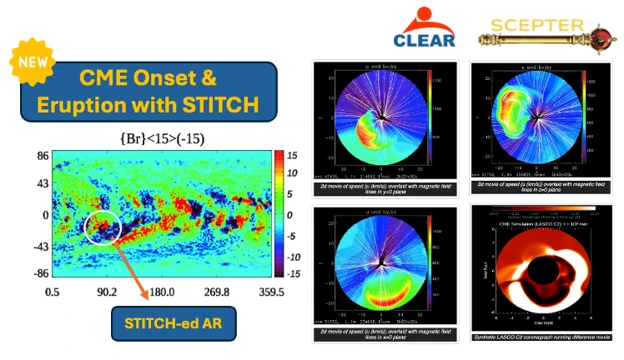
Rather than inserting a pre-existing twisted flux rope, the newly available STITCH approach models the formation and buildup of sheared magnetic structures in the low corona. STITCH is a physics-based subgrid-scale representation of helicity condensation. It injects tangential magnetic flux into the low corona to efficiently represent the accumulation of magnetic shear and free energy associated with the formation of filament channels.
Because the magnetic structure is built up within the simulation, STITCH can be used to investigate the pre-eruptive phase and the transition to eruption, rather than simply prescribing the CME flux-rope structure at the beginning of the simulation. This makes STITCH particularly advantageous for active regions with complicated or highly structured polarity inversion lines, where representing the buildup of shear and magnetic free energy is scientifically important.
Example Run: SWMF/AWSoM-R simulation of CME onset and eruption with STITCH model for a CME, Nishtha_Sachdeva_041326_SH_2
Both of these CME approaches are coupled to the SWMF/AWSoM-R global MHD framework, allowing the resulting CME to evolve from the solar corona into the inner heliosphere. AWSoM-R provides the ambient solar-wind environment and follows the CME's evolution through the corona and heliosphere, with synthetic remote-sensing and in situ observables available from the simulations.
For model details, available CME initiation options, and instructions for submitting a run, please visit the CCMC SWMF/AWSoM-R model page and the Eruptive Event Generator
New Shock-capturing Tool and SEP Visualization Capabilities in SWMF/AWSoM-R and MFLAMPA
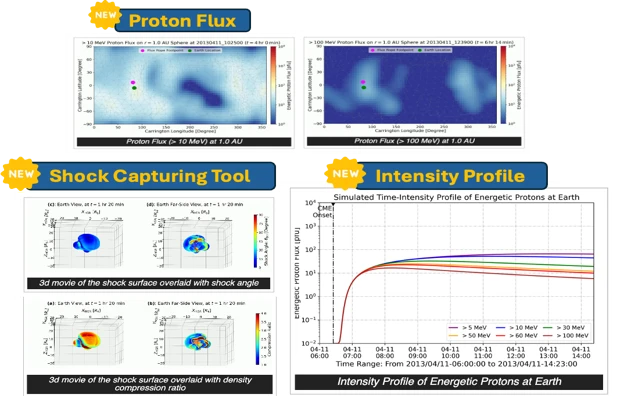
To identify and characterize the CME-driven shocks within the AWSoM-R CME simulations, a new shock-capturing tool is available at CCMC. The tool detects shocks by evaluating plasma and magnetic field discontinuities in the simulation domain and reconstructs the three-dimensional shock surface geometry with high fidelity. It calculates and provides key shock parameters such as the shock normal direction, compression ratio, and shock speed at each surface element. This detailed reconstruction enables accurate calculation of shock properties along the CME front, which are critical for understanding particle acceleration. These derived shock properties also enable analysis of shock evolution across the heliosphere and can serve as inputs to other SEP models.
Visualization Updates
Two additional visualization outputs are now available at CCMC for the SWMF-MFLAMPA model for simulating SEPs. The proton fluxes (>10 MeV and >100 MeV) and time-intensity profile for energetic protons at Earth are shown along with the shock-capturing tool outputs.
Example Run: SWMF/MFLAMPA simulation of SEPs at Earth with GL flux-rope model, Lulu_Zhao_072525_SH_1
Key references
- STITCH
- van der Holst, B., Antiochos, S. K., Sachdeva, N., et al. (2025), Modeling the Energy Release in Solar Eruptive Events, The Astrophysical Journal, 995, 2.
- Dahlin, J. T., DeVore, C. R., & Antiochos, S. K. (2022), STITCH: A Subgrid-Scale Model for Energy Buildup in the Solar Corona, The Astrophysical Journal, 941, 79.
- GL
- Jin, M., Manchester, W. B., van der Holst, B., et al. (2017), Data-constrained coronal mass ejections in a global magnetohydrodynamics model, The Astrophysical Journal, 834, 173.
- Borovikov, D., Sokolov, I. V., Manchester, W. B., Jin, M., & Gombosi, T. I. (2017), Eruptive event generator based on the Gibson-Low magnetic configuration, Journal of Geophysical Research: Space Physics, 122, 7979–7984.
- Jin, M., Manchester, W. B., van der Holst, B., et al. (2017), Chromosphere to 1 AU simulation of the 2011 March 7th event: A comprehensive study of coronal mass ejection propagation, The Astrophysical Journal, 834, 172.
- SEP, Shock-capturing
- Liu, W., Liu, X., Lario, D., et al. (2026), Counterintuitive Magnetic Connectivity and Energetic Particle Flux Differences among Nearby Observers during the 2023 February 24 Solar Energetic Particle Event, The Astrophysical Journal, 1008 6.
- Liu, W., Sokolov, I., Zhao, L. et al. (2025), Physics-based Simulation of the 2013 April 11 Solar Energetic Particle Event, The Astrophysical Journal, 985, 82.
Acknowledgement: This work is supported by NASA Space Weather Center of Excellence program award 80NSSC23M0191 (CLEAR) and the NASA Living With a Star (LWS) Strategic Capability project grant 80NSSC22K0892 (SCEPTER).